
The AI revolution for small businesses is here—but most are falling behind Recent OECD findings reveal that while AI adoption among SMEs is growing, most businesses are not maximizing its potential. Discover how customized AI solutions can help your business overcome the most common barriers to digital transformation.
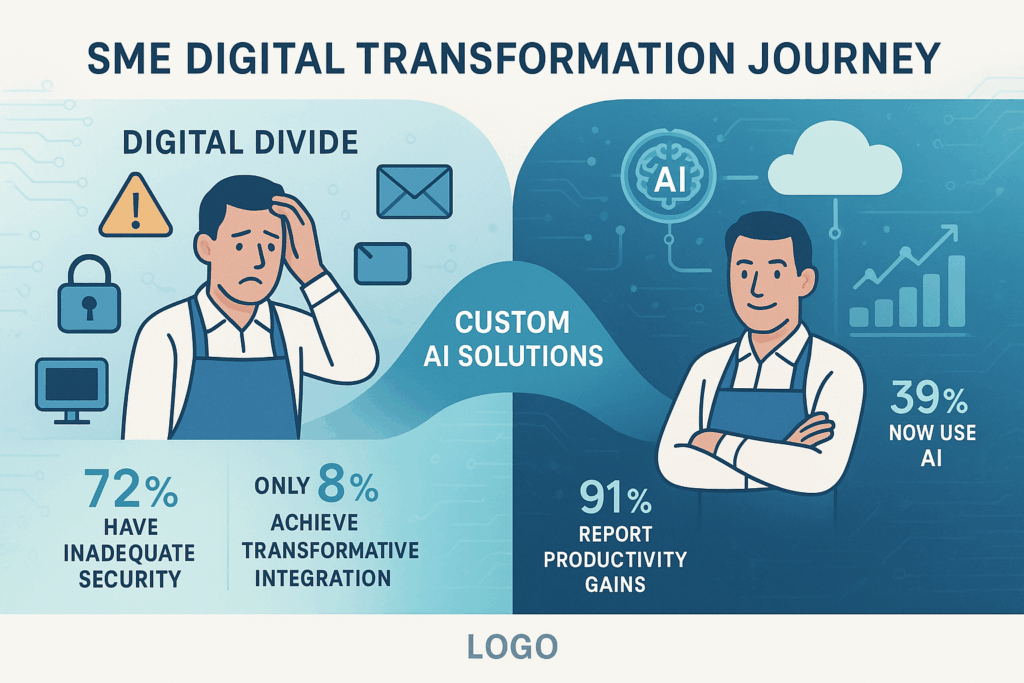
Key Findings from the OECD’s D4SME 2025 Survey on SME Digitalization
The Organisation for Economic Co-operation and Development (OECD) recently published its report “SME Digitalisation for Competitiveness,” offering essential insights into the adoption of artificial intelligence by small and medium-sized enterprises. After participating in a peer-learning exercise with the OECD, we at Daijobu AI identified several findings that directly affect how SMEs should approach their AI strategy in 2025 and beyond.
The State of AI Adoption among SMEs in 2025
The headline statistics show promising growth:
- 39% of SMEs now use AI applications (up from 26% in 2024)
- 26% specifically use generative AI (up from 18% last year)
- 17% acknowledge that they use AI passively through platforms they already use
However, deeper analysis reveals concerning gaps:
- Only 8% of businesses have achieved “transformative” digital integration
- 16% remain at basic levels of digital adoption
- 72% have inadequate digital-security measures
These statistics highlight a widening digital divide between businesses that fully leverage AI and those that are barely scratching the surface of its potential.
Top 5 Barriers to AI Adoption for Small Businesses
The OECD study identified the main obstacles preventing SMEs from fully embracing digital transformation:
- Maintenance costs (40%) – Ongoing expenditure on software updates, patches, and technical support
- Lack of time for training (39%) – Insufficient capacity to develop the necessary skills
- Hardware costs (32%) – Upfront investment in the required equipment
- Understanding digital regulations (26%) – Navigating complex compliance requirements
- Training costs (24%) – Expenditure associated with formal skills development
Notably, cultural resistance ranked among the lowest barriers, with only 7% citing management resistance and 6% citing employee resistance as significant obstacles.
Why Generic AI Solutions Fail Small Businesses
The research confirms a concerning trend: standard AI products rarely meet the specific needs of SMEs. Among businesses aware of digital-support programs but not using them, 27% stated that “the support available was not suited to their needs.”
This mismatch occurs because generic AI solutions typically:
- Require businesses to adapt their processes to the technology
- Lack customization for industry-specific applications
- Provide minimal control over data and algorithms
- Come with substantial hidden training and maintenance costs
As the OECD research shows, only 21% of SMEs are even aware of government support programs for digitalization, and only half of those businesses actually benefit from these programs.
Digital Security: The Growing Threat to AI Adoption by SMEs
Perhaps the most alarming finding concerns digital-security vulnerabilities. The OECD report found that:
- 32% of SMEs experienced a security breach over the past year (double the 2024 rate)
- 9% of businesses have no digital-security measures whatsoever
- 63% have only basic or intermediate safeguards
- Only 12% conduct regular cybersecurity assessments with experts
As AI adoption increases without adequate security infrastructure, these vulnerabilities will only multiply—creating significant business risks.
How Customized AI Solutions Address These Challenges
Customized AI solutions designed specifically for SMEs address these obstacles in several ways:
- Cost management: AI-as-a-service models turn substantial upfront investment into manageable operating expenditure
- Reduced complexity: dedicated frameworks can reduce implementation complexity by up to 20 times
- Enhanced security: sovereign infrastructure with comprehensive control systems
- True customization: models trained exclusively on client data for optimal performance
- Data control: transparent tools that give clients full ownership of their information
The Business Impact of AI for SMEs: Real Benefits
The OECD research identified the main benefits SMEs report from successful digital adoption:
- Process automation (53%) – Fewer manual tasks and greater efficiency
- Customer-base expansion (39%) – Reaching new markets and demographics
- Increased domestic sales (35%) – Revenue growth in existing markets
- Improved business monitoring (24%) – Better data-driven decision-making
Among businesses specifically using generative AI, the benefits were even more pronounced:
- 91% reported significant productivity improvements
- 76% experienced enhanced innovation capabilities
- 66% were able to operate with reduced staffing needs
- 62% discovered new revenue streams
How to Get Started with Customized AI for Your Business
If you are looking to implement a more effective AI strategy for your small or medium-sized business, consider these steps:
- Assess your level of digital maturity using the OECD framework
- Identify the specific business processes that could benefit most from AI enhancement
- Evaluate your current digital-security measures against industry standards
- Consider leasing modelsthat minimize upfront costs
- Prioritize solutions that offer data ownership and control
Conclusion: The Future of AI for Small Businesses
OECD projections suggest that AI will contribute 15,7 trillion euros to the global economy by 2030. For SMEs to capture their share of this growth, they need AI solutions that are:
- Specifically tailored to their unique needs
- Affordable and accessible without massive upfront investment
- Secure and compliant with evolving regulations
- Designed to enhance rather than replace human capabilities
At Daijobu AI, we are committed to democratizing access to customized AI solutions that help small and medium-sized enterprises bridge the digital divide and compete in an increasingly AI-driven market.
Want to know how customized AI can transform your business operations? Contact Daijobu AI today to schedule a personalized demonstration.
Sources: “SME Digitalisation for Competitiveness: The OECD D4SME Survey 2025”by Marco Bianchini and Marta Lasheras Sancho, Organisation for Economic Co-operation and Development (OECD).